
Swollen Knee Without Injury
A knee that swells without an injury usually means fluid from inflammation, infection or crystals. It should be evaluated promptly.
Meet Dr. Syed Alam, MD, FACR
Double Board-Certified, Fellowship-Trained Rheumatologist · Musculoskeletal Ultrasound Trained · 10+ Years of Experience
Dr. Alam completed his rheumatology fellowship at Temple University Hospital after an internal medicine residency at John H. Stroger, Jr. Hospital. His clinical interests include rheumatoid arthritis, lupus, psoriatic arthritis, gout, Sjögren’s disease, osteoporosis and other rheumatic conditions.
Read the full profile →
What a swollen knee means
The knee is the largest joint in the body and holds more fluid than any other, so swelling there is unusually visible. When it swells without an injury, it means the joint lining is producing excess fluid, and that happens for a limited number of reasons: inflammation, crystals, infection, or bleeding.
Because the causes range from entirely manageable to genuinely urgent, a knee that swells spontaneously deserves assessment rather than watchful waiting, particularly if it is hot or you feel unwell.
How to tell there is fluid
The natural dips either side of the kneecap disappear. The knee feels tight, especially when bending, and may not fully straighten. Pressing on one side can make the other side bulge. The joint often feels warm compared with the other knee.
Not sure whether your symptoms need a specialist? A rheumatology evaluation can give you a clear answer.
Request an AppointmentThe main causes
Crystal arthritis
Gout and pseudogout are among the most common causes of a suddenly swollen knee in adults. Pseudogout in particular favours the knee, often in older people, and can be triggered by an illness, surgery or dehydration. Both cause rapid onset with heat and severe pain.
Septic arthritis
Joint infection is the diagnosis that must not be missed. It usually affects a single joint which becomes hot, very swollen and severely painful over hours, often with fever. It needs same-day assessment because delay causes permanent damage. Risk is higher in people with diabetes, existing joint disease, recent joint injection or a suppressed immune system.
Inflammatory arthritis
A knee is a common first site for spondyloarthritis, psoriatic arthritis and reactive arthritis, particularly in younger adults. Look for heel pain, back stiffness, psoriasis, eye inflammation or a recent gut or genitourinary infection.
Osteoarthritis
Usually causes gradual pain and stiffness rather than sudden swelling, but an osteoarthritic knee can produce an effusion, particularly after a period of increased activity.
Mechanical causes without obvious injury
A degenerate meniscal tear can occur with a minor twist that you may not even remember, and produces recurrent swelling related to activity.
Early assessment gives you the widest range of treatment options.
Book an Evaluation
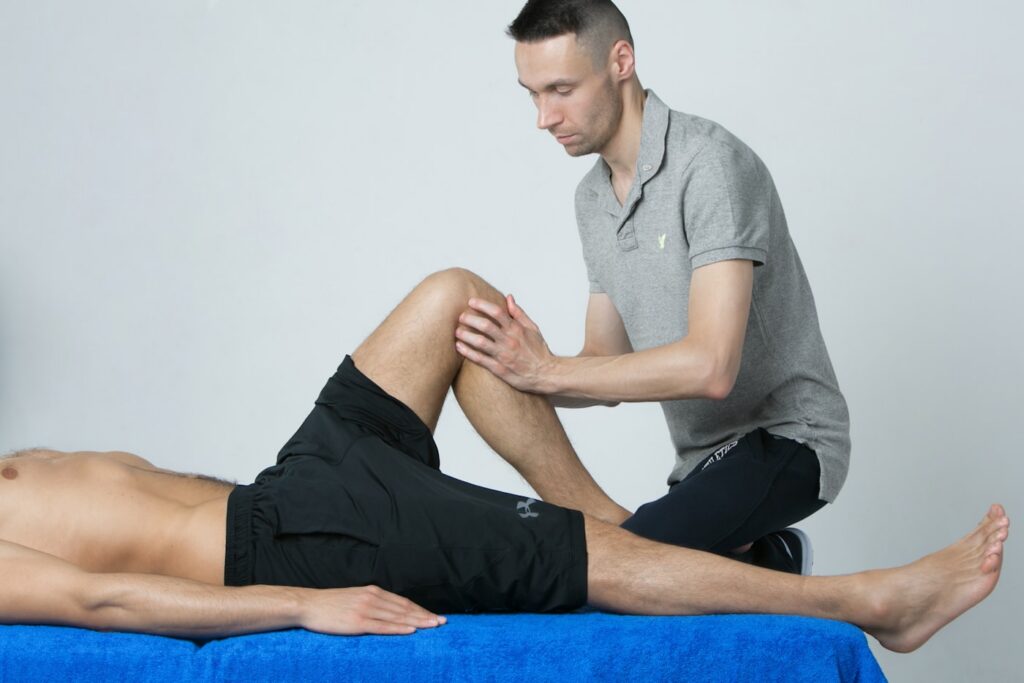
Photo for illustration. Images do not depict patients of this practice.
How urgent is it?
Use these as a guide, and err on the side of being seen.
Same-day assessment
- A hot, very swollen, severely painful knee, especially with fever or feeling unwell
- Inability to bear weight
- Recent joint injection, surgery, or a break in the skin near the joint
- A suppressed immune system, diabetes, or existing joint disease
Prompt but routine assessment
- Swelling that has persisted more than a couple of weeks
- Swelling that keeps coming back
- Swelling with back stiffness, heel pain, psoriasis or eye inflammation
- Swelling in a young adult with no injury
How it is investigated
Joint aspiration
Drawing off fluid with a needle is quick, usually relieves pressure and pain immediately, and provides the fastest answer available. The fluid is examined for crystals, white cells and bacteria, which distinguishes gout and pseudogout from infection and from inflammatory arthritis. If a knee is hot and swollen, this is often the most useful single step.
Blood tests
- Full blood count, ESR and CRP
- Uric acid, keeping in mind that it falls during an acute attack
- Rheumatoid factor, anti-CCP and HLA-B27 where the pattern suggests inflammatory arthritis
- Blood cultures if infection is suspected
Imaging
X-rays can show calcium deposits in the cartilage that support pseudogout, along with any established joint damage. Ultrasound confirms fluid and guides aspiration. MRI is reserved for suspected internal derangement such as a meniscal tear.
We will take a full history, examine every affected joint and order only the tests that change your care.
Schedule Your VisitWhat to do meanwhile
- Rest the knee but keep moving it gently through a comfortable range.
- Apply ice for 15 to 20 minutes several times a day.
- Elevate the leg when sitting.
- Avoid deep squats, kneeling and stairs where you can.
- Photograph the knee alongside the other one for comparison.
- Note your temperature; fever with a swollen knee changes the urgency.
Anti-inflammatory tablets can help if they are safe for you. Do not take steroids before assessment unless a doctor has advised it, since they can mask infection and confuse the diagnosis.
Treatment is matched to your diagnosis, your other conditions and your goals.
Start Your Treatment PlanWhat joint aspiration involves
Being told a needle is going into your swollen knee is understandably unwelcome, but joint aspiration is one of the most useful and least difficult procedures in rheumatology, and it usually makes the knee feel better immediately.
What happens
You lie down with the knee slightly bent and supported. The skin is cleaned thoroughly and local anaesthetic is used. A needle is inserted at the side of the kneecap, where there are no major structures, and the fluid is drawn off. The whole thing takes a few minutes. Ultrasound is sometimes used to guide the needle.
What it feels like
Most people describe pressure rather than sharp pain, and considerable relief as the tension in the joint is released. The knee is often more comfortable and easier to bend immediately afterwards.
What the fluid tells us
- Crystals under polarised light confirm gout or pseudogout definitively
- White cell count distinguishes inflammatory from mechanical causes
- Culture identifies infection, which changes treatment immediately
- Blood in the fluid suggests injury or a bleeding problem
- Clear, low-cell fluid points towards osteoarthritis
Afterwards
You can usually walk out and resume normal activity, avoiding heavy loading for a day or two. If infection has been excluded, a steroid injection is sometimes given at the same time, which settles inflammation quickly. Infection at the injection site is rare, but report increasing pain, redness or fever afterwards.
No blood test provides the information that joint fluid does, which is why this is often the fastest route to a firm diagnosis.
When to see a rheumatologist in Katy
See a rheumatologist if a knee has been swollen for more than two weeks, if it has swollen more than once, if there is no injury to explain it, or if it comes with back stiffness, heel pain, psoriasis or eye inflammation.
Seek same-day care rather than a routine appointment if the knee is hot and severely painful with fever, because joint infection is treatable when caught quickly and damaging when it is not.
New patients are welcome at our Katy clinic, and a referral is not required for most plans.
Talk to Our RheumatologistPLACEHOLDER: this page must be reviewed and approved by Dr. Syed Alam before launch. Add the review date here.
Frequently asked questions
Swollen Knee Without Injury: your questions answered
Why would my knee swell with no injury?
Spontaneous swelling means the joint lining is producing excess fluid, which happens with inflammation, crystals such as gout or pseudogout, or infection. It is worth assessing rather than waiting, particularly if the knee is hot.
Is a swollen knee an emergency?
It can be. A hot, very swollen, severely painful knee with fever needs same-day assessment to exclude joint infection. Swelling that is mild, not hot and not accompanied by feeling unwell can usually wait for a routine appointment.
What is fluid on the knee?
An effusion: excess fluid inside the joint capsule. It makes the knee feel tight, limits bending and straightening, and causes the normal dips beside the kneecap to disappear. Draining it relieves pressure and provides diagnostic information.
Does draining the knee hurt?
It is uncomfortable but brief, and local anaesthetic is used. Most people find the relief of pressure outweighs the discomfort, and the fluid gives answers that no blood test can provide as quickly.
Can gout affect the knee?
Yes. Although gout classically starts in the big toe, the knee is a common site, and pseudogout favours the knee in particular. Both cause rapid, painful swelling with heat.
Should I keep walking on it?
Gentle movement through a comfortable range is helpful, but avoid deep bending, kneeling and prolonged weight-bearing while it is acutely swollen. If you cannot bear weight at all, seek assessment promptly.
Will it need surgery?
Usually not. Most spontaneous knee swelling is treated medically once the cause is identified. Surgery is considered for mechanical problems such as a meniscal tear, or for advanced osteoarthritis affecting quality of life.
What if it keeps coming back?
Recurrent swelling points to crystal arthritis, inflammatory arthritis or a mechanical problem, and it deserves a definitive diagnosis. Being seen while the knee is actually swollen gives far more information than being seen afterwards.
Still have a question?
Our office is happy to answer questions before you book. Call us or send a request and we will call you back.
Ask Us Your QuestionGet started
Get an evaluation at our Katy clinic
You do not need a diagnosis to make an appointment. Our rheumatologist will help find the cause.