
Swollen Hands and Fingers
Swelling of the hands and fingers without injury, especially in the morning, is a common early sign of inflammatory arthritis.
Meet Dr. Syed Alam, MD, FACR
Double Board-Certified, Fellowship-Trained Rheumatologist · Musculoskeletal Ultrasound Trained · 10+ Years of Experience
Dr. Alam completed his rheumatology fellowship at Temple University Hospital after an internal medicine residency at John H. Stroger, Jr. Hospital. His clinical interests include rheumatoid arthritis, lupus, psoriatic arthritis, gout, Sjögren’s disease, osteoporosis and other rheumatic conditions.
Read the full profile →
Why hands and fingers swell
The hands contain many small joints in a small space, and they are where inflammatory arthritis most often declares itself. When the lining of these joints becomes inflamed it thickens and produces extra fluid, so the knuckles lose their definition and the fingers feel puffy and difficult to bend.
Because we use our hands constantly, even modest swelling is noticeable. People often describe rings that no longer fit, difficulty making a full fist first thing, or trouble with buttons, jar lids and keys. Those functional details are worth mentioning, because they tell a rheumatologist how much the swelling is actually affecting you.
Which knuckles are involved
This is one of the most useful distinctions in the whole examination. Swelling of the large knuckles where the fingers meet the hand, and of the middle finger joints, points towards rheumatoid arthritis. Bony enlargement of the joints nearest the fingernails, and at the base of the thumb, points towards osteoarthritis. Swelling of a whole finger from base to tip suggests psoriatic arthritis.
Not sure whether your symptoms need a specialist? A rheumatology evaluation can give you a clear answer.
Request an AppointmentWhat to look for
- Puffy knuckles that have lost their normal hollows
- Rings that have become tight or will no longer go on
- Difficulty making a full fist, especially in the first hour of the day
- Warmth over the joints, and sometimes a slight pink flush
- Reduced grip strength: dropping things, struggling with jars and taps
- The same joints affected on both hands
- A whole finger or toe swollen along its length
Swelling that is not in the joints
Not all hand swelling is arthritis. Generalised puffiness of the whole hand, worse in hot weather, after salty food or at the end of the day, is usually fluid retention. Swelling of one hand after an insect bite or minor injury is local. Swelling with numbness and tingling in the thumb, index and middle fingers suggests carpal tunnel syndrome, which can itself accompany inflammatory arthritis or thyroid disease.
Early assessment gives you the widest range of treatment options.
Book an Evaluation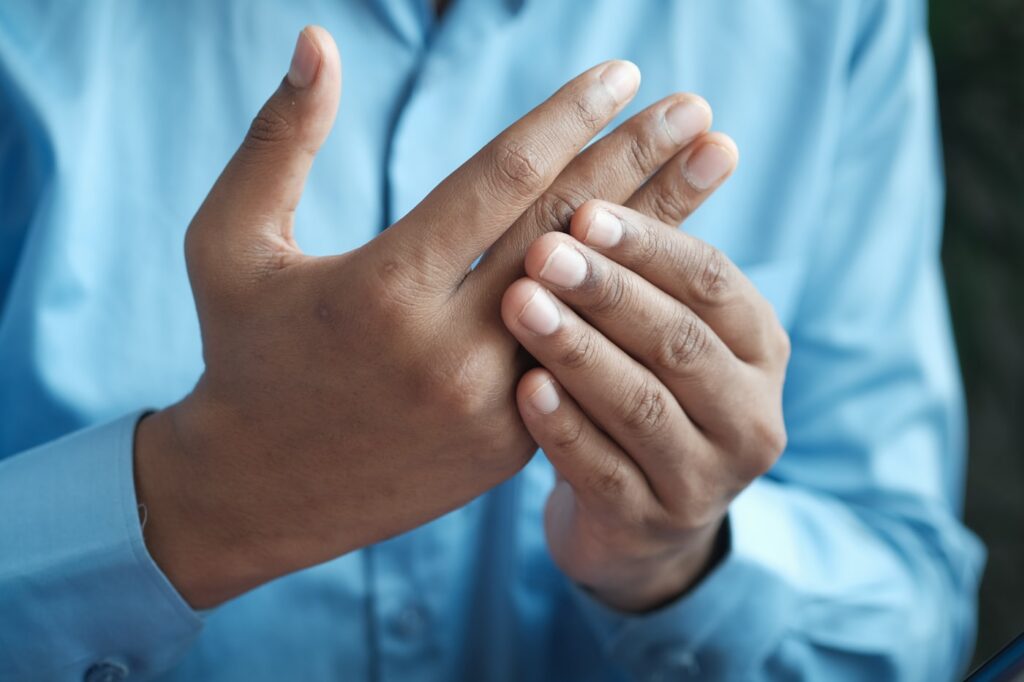
Photo for illustration. Images do not depict patients of this practice.
Conditions that cause swollen hands and fingers
Rheumatoid arthritis
The most important cause to identify early. It typically produces symmetrical swelling of the knuckles and wrists with morning stiffness lasting over an hour, and it responds well to treatment started promptly.
Psoriatic arthritis
May affect a few fingers asymmetrically, often including the joints nearest the nails, and characteristically causes whole-digit swelling. Look for psoriasis anywhere, including the scalp and navel, and for nail pitting or separation.
Osteoarthritis of the hands
Causes firm, bony enlargement of the finger joints nearest the nails and at the thumb base. It runs strongly in families, is more common after menopause, and produces aching that worsens with use.
Lupus and other connective tissue diseases
Can cause joint swelling in the hands alongside fatigue, rash, mouth ulcers or hair loss. The joint disease is usually less destructive than rheumatoid arthritis but the systemic features matter.
Gout
Less often thought of in the hands, but longstanding gout affects the fingers and wrists and can be mistaken for rheumatoid arthritis, particularly when several joints are involved.
How it is evaluated
The assessment begins with the hands themselves but does not end there. Your rheumatologist examines each small joint for swelling and tenderness, tests grip, checks the wrists and elbows, and then looks at the feet, which are involved surprisingly often and are easy for patients to overlook.
Tests
- Rheumatoid factor and anti-CCP antibodies
- ESR and CRP as measures of inflammation
- A blood count, kidney and liver function
- Uric acid if gout is possible
- Thyroid function, since thyroid disease causes hand symptoms too
Imaging
X-rays of the hands and feet give a baseline and show any erosion already present. Ultrasound is more sensitive and can confirm inflammation in a joint or tendon sheath when the examination is uncertain, which is particularly helpful early in the disease.
We will take a full history, examine every affected joint and order only the tests that change your care.
Schedule Your VisitWhat you can do now
- Photograph your hands on a bad morning; swelling often settles before your appointment.
- Note the time your hands move normally each morning for several days.
- Remove rings early rather than waiting until they will not come off.
- Use wider grips on pens, tools and kitchen utensils to reduce strain.
- Keep moving the fingers through their full range several times a day.
- Avoid gripping tasks that leave the hands more swollen the next morning.
Splints can help at night for wrist symptoms, and warmth in the morning speeds up loosening. Neither treats the underlying cause, so use the waiting time to gather information rather than to delay assessment.
Treatment is matched to your diagnosis, your other conditions and your goals.
Start Your Treatment PlanProtecting hand function day to day
Hands do more work than any other joints, and small adjustments make a real difference to how they feel at the end of the day. None of this replaces treatment, but it reduces the load while the underlying cause is addressed.
Reduce the force you need
- Use wider grips on pens, knives, toothbrushes and garden tools
- Fit lever handles on taps and doors rather than round knobs
- Use an electric tin opener and a jar opener rather than gripping harder
- Carry bags over the forearm or shoulder rather than hooked on the fingers
- Push doors with the forearm rather than pulling with the fingers
Spread the load and pace the day
Use both hands for heavier tasks, break long jobs into shorter blocks, and alternate demanding activities with lighter ones. If your hands are noticeably more swollen the following morning, the previous day was too much, and that feedback is more reliable than how it felt at the time.
Keep the joints moving
Take the fingers gently through their full range several times a day, particularly after periods of stillness. Movement maintains the range you have; avoiding it is what causes lasting stiffness. Warmth first thing, whether a warm shower or warm water, speeds up loosening considerably.
Splints
A resting splint worn at night can settle wrist symptoms and is worth asking about, particularly if you also have numbness or tingling suggesting carpal tunnel syndrome. Splints are not for daytime use in most cases, since immobility works against you.
When to see a rheumatologist in Katy
Ask for an evaluation if hand or finger swelling has lasted more than six weeks, if morning stiffness lasts over an hour, if both hands are affected, if a whole finger is swollen, or if you have psoriasis and new joint symptoms.
Hand involvement is one of the clearest early signals of inflammatory arthritis, and it is also where treatment makes the biggest difference to long-term function. Being assessed early costs an appointment; waiting can cost grip and dexterity.
New patients are welcome at our Katy clinic, and a referral is not required for most plans.
Talk to Our RheumatologistPLACEHOLDER: this page must be reviewed and approved by Dr. Syed Alam before launch. Add the review date here.
Frequently asked questions
Swollen Hands and Fingers: your questions answered
Why are my fingers swollen in the morning but fine by lunchtime?
That pattern is typical of inflammation. Fluid accumulates in the joints overnight and disperses once you start moving. Mechanical problems do the opposite, worsening as you use the hand through the day.
What does it mean if a whole finger is swollen?
Swelling of an entire finger or toe, called dactylitis or a sausage digit, is caused by inflammation of the joints and tendon sheaths together. It is highly characteristic of psoriatic arthritis and is worth reporting specifically.
Is hand swelling always arthritis?
No. Fluid retention, heat, salt, pregnancy, thyroid disease and carpal tunnel syndrome all cause hand symptoms. The pattern that matters is joint-centred swelling with prolonged morning stiffness, particularly when both hands are affected.
My rings are tight. Should I be worried?
Not necessarily, but it is worth noticing. If it fluctuates with heat and salt it is probably fluid. If it is persistent, worse in the morning and accompanied by stiffness or difficulty making a fist, arrange an assessment.
Which finger joints does osteoarthritis affect?
Typically the joints nearest the fingernails and the joint at the base of the thumb, producing firm bony enlargement. Swelling of the large knuckles is much less typical of osteoarthritis and points towards inflammation.
Can I still use my hands normally?
Yes, and you should. Keeping the fingers moving through their full range preserves function. Modify grip-heavy tasks rather than stopping activity, and use wider handles to reduce load on the small joints.
Will I need X-rays?
Usually yes, as a baseline of the hands and feet. Ultrasound may be added, since it detects inflammation earlier than X-ray and can settle the question when the examination is borderline.
Do normal blood tests rule out arthritis in my hands?
No. About one in five people with rheumatoid arthritis have negative rheumatoid factor and anti-CCP, and inflammation markers are often normal early on. Swelling found on examination carries more weight than a normal result.

Still have a question?
Our office is happy to answer questions before you book. Call us or send a request and we will call you back.
Ask Us Your QuestionGet started
Get an evaluation at our Katy clinic
You do not need a diagnosis to make an appointment. Our rheumatologist will help find the cause.