
Psoriasis and Joint Pain
Up to one in three people with psoriasis develop psoriatic arthritis. Joint pain, swollen fingers or heel pain with psoriasis should be evaluated.

Meet Dr. Syed Alam, MD, FACR
Double Board-Certified, Fellowship-Trained Rheumatologist · Musculoskeletal Ultrasound Trained · 10+ Years of Experience
Dr. Alam completed his rheumatology fellowship at Temple University Hospital after an internal medicine residency at John H. Stroger, Jr. Hospital. His clinical interests include rheumatoid arthritis, lupus, psoriatic arthritis, gout, Sjögren’s disease, osteoporosis and other rheumatic conditions.
Read the full profile →
The link between skin and joints
Psoriasis and psoriatic arthritis are driven by the same immune pathways. The signals that make skin cells multiply too quickly also inflame the joints, the places where tendons attach to bone, and sometimes the spine. That is why they belong to one condition rather than two coincidental problems.
Around a third of people with psoriasis develop joint involvement, usually years after the skin disease, though in roughly 15 percent of cases the joints come first. Because psoriasis can be limited to the scalp, the navel or the nails, some people have never been told they have it.
Skin severity does not predict joint severity
This surprises most patients. Someone with a few small patches can develop significant arthritis, while someone with extensive plaques may never have joint problems. It also means a dermatologist being pleased with your skin says nothing about your joints, and joint symptoms need reporting on their own account.
Not sure whether your symptoms need a specialist? A rheumatology evaluation can give you a clear answer.
Request an AppointmentWhat psoriatic joint pain feels like
- Pain, swelling and stiffness in one or more joints, often not matching side to side
- Morning stiffness lasting more than 30 minutes
- An entire finger or toe swollen along its length, called dactylitis
- Pain at the back of the heel or under the heel, where tendons attach
- Lower back or buttock pain that is worse after rest and better with movement
- Reduced grip strength, or difficulty walking first thing in the morning
Heel pain deserves particular mention
Inflammation where tendons attach to bone, called enthesitis, is a hallmark of psoriatic arthritis. It commonly causes heel pain that is repeatedly diagnosed as plantar fasciitis or a sports injury and never quite settles. In someone with psoriasis, persistent heel pain is a reason to be assessed rather than to keep stretching.
Nail changes
Pitting, small dents in the nail surface, separation of the nail from its bed, and thickening or discoloration are all relevant. Nail involvement is associated with a higher risk of joint disease, particularly of the joints nearest the fingertips.
Early assessment gives you the widest range of treatment options.
Book an Evaluation
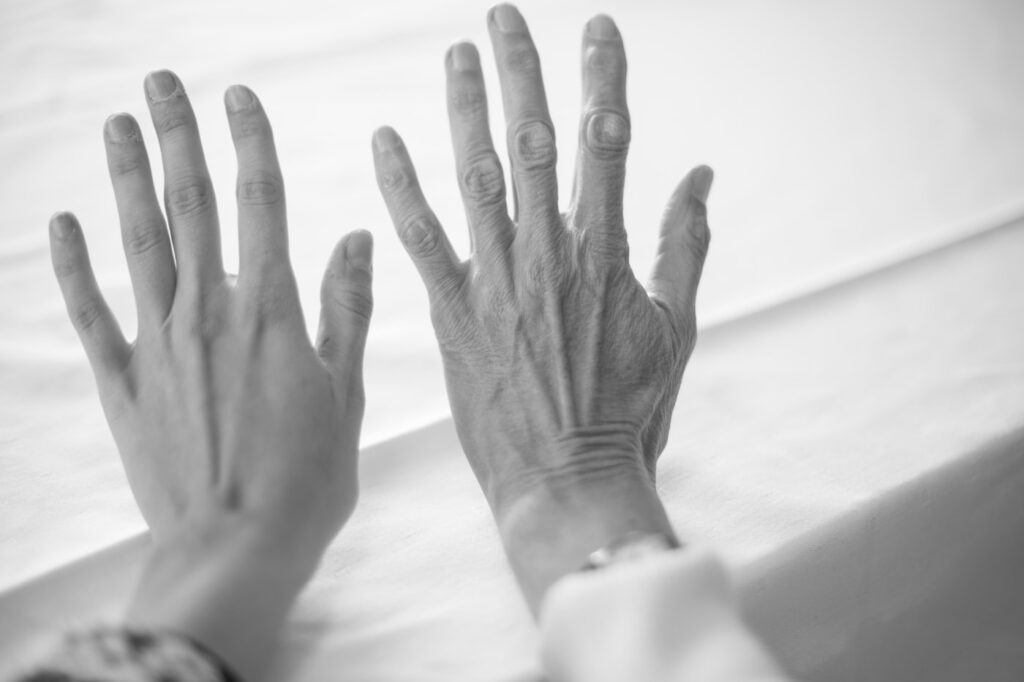
Photo for illustration. Images do not depict patients of this practice.
Other reasons someone with psoriasis might have joint pain
Having psoriasis does not mean every ache is psoriatic arthritis, and the alternatives are worth considering.
- Osteoarthritis, particularly in the knees, hips and the finger joints nearest the nails
- Gout, which is more common in people with psoriasis because of higher cell turnover
- Fibromyalgia, causing widespread pain without joint swelling
- Mechanical injury or overuse
- Rheumatoid arthritis occurring coincidentally
The distinction matters because treatment differs completely. Immune-modifying medication helps psoriatic arthritis and does nothing for osteoarthritis or fibromyalgia, while gout needs uric acid lowered rather than the immune system suppressed.
How it is assessed
There is no blood test that confirms psoriatic arthritis. The diagnosis is clinical, built from the joint pattern, the skin and nails, imaging and the exclusion of other causes.
Examination
Your rheumatologist examines each joint for swelling, checks tendon insertion points at the heels and elbows, looks for whole-digit swelling, assesses spinal movement, and inspects the skin and nails, including areas patients often do not think to mention such as the scalp, navel and the crease between the buttocks.
Tests
- ESR and CRP, though these are normal in many people with active psoriatic arthritis
- Rheumatoid factor and anti-CCP, usually negative, which helps distinguish it from rheumatoid arthritis
- Uric acid, since gout can coexist and mimic a flare
- HLA-B27 where the spine is involved
Imaging
Ultrasound is particularly good at showing enthesitis and early joint inflammation. X-rays give a baseline, and MRI is used where spinal or sacroiliac involvement is suspected but not visible on X-ray.
We will take a full history, examine every affected joint and order only the tests that change your care.
Schedule Your VisitWhat you can do now
- Tell your rheumatologist about all psoriasis, including scalp, nails and hidden areas.
- Photograph any swollen finger or toe; dactylitis often settles between appointments.
- Report heel pain specifically rather than treating it as a separate sports problem.
- Keep moving. Stiffness improves with activity and worsens with prolonged rest.
- Manage weight, which affects both disease activity and how well biologic treatment works.
- Report a painful, red, light-sensitive eye immediately, as uveitis needs urgent care.
If you already see a dermatologist, tell them about the joint symptoms and tell your rheumatologist about the skin treatment. Coordinating the two often means one medicine can control both.
Treatment is matched to your diagnosis, your other conditions and your goals.
Start Your Treatment PlanWorking with dermatology and rheumatology together
Psoriatic disease sits across two specialties, and patients frequently end up managing the communication between them. A little organisation makes the care considerably better.
Why coordination matters
Several biologic medicines treat both the skin and the joints. If each specialty prescribes separately, you may end up on two treatments where one would do, with double the cost and double the infection risk. Conversely, a treatment chosen purely for skin may do nothing for the joints, and vice versa.
What to tell each specialist
- Tell your dermatologist about joint pain, swelling, heel pain and back stiffness
- Tell your rheumatologist where your psoriasis is, including scalp, nails and hidden areas
- Tell both about every medicine you are taking, including topical treatments
- Report any new eye redness or pain to whoever you can reach first
- Mention bowel symptoms, since inflammatory bowel disease changes drug choice
Treatments that cover both
Methotrexate helps skin and peripheral joints. Biologics blocking TNF, interleukin-17 or interleukin-23 can improve skin, joints, nails and tendon insertions together. Which is chosen depends on which features dominate, whether the spine is involved, and your other medical conditions.
One point worth repeating
Clear skin does not mean quiet joints. If your skin is well controlled but your joints hurt, that is not a contradiction and it is not something to put up with. Report it, because joint damage progresses independently of how the skin looks.
When to see a rheumatologist in Katy
If you have psoriasis and develop joint pain, swollen fingers or toes, persistent heel pain or morning back stiffness, ask for a rheumatology evaluation rather than waiting to see whether it settles.
You do not need visible psoriasis to be assessed. Nail changes, a family history, or unexplained whole-digit swelling are all reasons to be seen. Joint damage in psoriatic arthritis can begin within the first year or two, and current treatments are very effective at preventing it when started early.
New patients are welcome at our Katy clinic, and a referral is not required for most plans.
Talk to Our RheumatologistPLACEHOLDER: this page must be reviewed and approved by Dr. Syed Alam before launch. Add the review date here.
Possible causes
Conditions associated with this
Frequently asked questions
Psoriasis and Joint Pain: your questions answered
Does psoriasis always lead to arthritis?
No. About one in three people with psoriasis develop psoriatic arthritis. Most do not. But because joint damage can start early, new joint symptoms in someone with psoriasis are worth assessing rather than watching.
Can I have psoriatic arthritis without visible psoriasis?
Yes. In roughly 15 percent of cases joint symptoms come first, sometimes by years. Psoriasis can also be hidden on the scalp, in the navel or between the buttocks, or show only as nail changes.
What are sausage fingers?
Dactylitis: swelling of an entire finger or toe rather than a single joint, caused by inflammation of the joints and tendon sheaths together. It is one of the most distinctive signs of psoriatic arthritis and worth photographing.
Why does my heel hurt?
Inflammation where the Achilles tendon or plantar fascia attaches to bone, called enthesitis, is characteristic of psoriatic arthritis. It is frequently mistaken for plantar fasciitis and does not settle with standard treatment for that.
Should I see a dermatologist or a rheumatologist?
A rheumatologist for the joints. Many patients see both, and coordinating care often allows one medicine to treat the skin and joints together, avoiding duplicated treatment.
Does clearing my skin help my joints?
Sometimes. Several biologic medicines treat both effectively. But topical skin treatments do nothing for joint inflammation, and joint disease can be active while the skin looks clear.
Will treatment stop joint damage?
Modern treatments are very effective at preventing damage when started early, which is the main argument for prompt assessment rather than waiting to see how symptoms develop.
Are nail changes important?
Yes. Pitting and separation of the nail are associated with a higher risk of joint involvement, particularly of the joints nearest the fingertips. Mention them even if they seem cosmetic.
Still have a question?
Our office is happy to answer questions before you book. Call us or send a request and we will call you back.
Ask Us Your QuestionGet started
Get an evaluation at our Katy clinic
You do not need a diagnosis to make an appointment. Our rheumatologist will help find the cause.