
Osteoporosis Treatment in Katy, TX
Osteoporosis weakens bone and raises the risk of fracture, usually without any symptoms until a bone breaks. It is straightforward to screen for and highly treatable, and preventing that first fracture is one of the most valuable things rheumatology care can do.
Meet Dr. Syed Alam, MD, FACR
Double Board-Certified, Fellowship-Trained Rheumatologist · Musculoskeletal Ultrasound Trained · 10+ Years of Experience
Dr. Alam completed his rheumatology fellowship at Temple University Hospital after an internal medicine residency at John H. Stroger, Jr. Hospital. His clinical interests include rheumatoid arthritis, lupus, psoriatic arthritis, gout, Sjögren’s disease, osteoporosis and other rheumatic conditions.
Read the full profile →
What is osteoporosis?
Bone is living tissue that is constantly renewed. Old bone is removed and new bone is laid down in its place. Up to about the age of 30 we build more than we lose, reaching peak bone mass. After that the balance gradually tips the other way.
Osteoporosis develops when bone is lost faster than it is replaced. The bone becomes porous and its internal architecture thins, so it can break under a force that would not have harmed it before, such as a fall from standing height, a heavy cough, or in some cases no obvious injury at all.
Osteopenia and osteoporosis
Osteopenia describes bone density that is lower than normal but not yet in the osteoporosis range. It is not a disease in itself and does not automatically require medication, but it does identify people who should protect their bone health and be reassessed. Whether treatment is recommended depends on your overall fracture risk, not on the density number alone.
Why fractures matter so much
Osteoporotic fractures are not simply broken bones. A hip fracture often causes lasting loss of independence, and spinal fractures can cause chronic pain, height loss and a stooped posture. Once you have had one fragility fracture, your risk of another rises sharply, which makes that moment an important opportunity to start treatment.
Not sure whether your symptoms need a specialist? A rheumatology evaluation can give you a clear answer.
Request an AppointmentSymptoms and warning signs
Osteoporosis itself does not hurt. That is precisely what makes it dangerous, and why screening rather than symptoms drives diagnosis.
- A broken bone from a minor fall, particularly of the wrist, hip, spine or upper arm
- Loss of height, often more than an inch and a half over time
- A stooped posture or a rounded upper back
- Sudden, severe back pain that may indicate a vertebral fracture
- Back pain that came on without an obvious injury
Silent spinal fractures
Many spinal fractures cause no acute pain and are found incidentally on an X-ray or chest scan performed for another reason. They still matter, because they carry the same increased risk of future fracture as a painful one, and they are an indication to treat.
Early assessment gives you the widest range of treatment options.
Book an Evaluation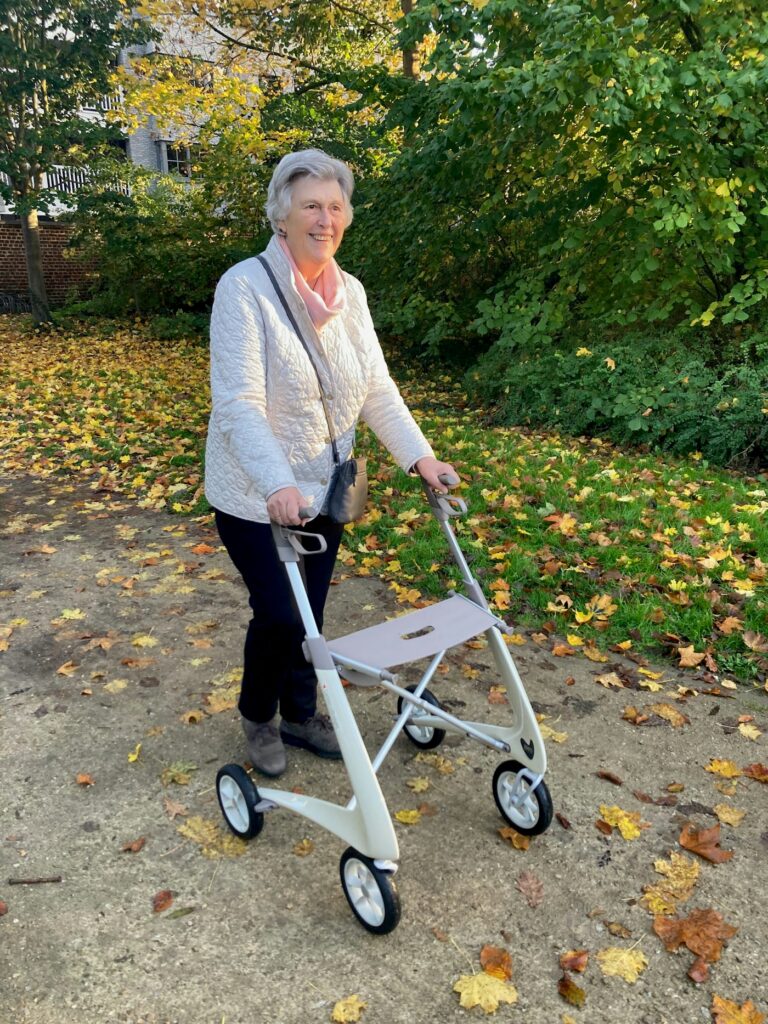
Photo for illustration. Images do not depict patients of this practice.
Who is at risk of osteoporosis?
Factors you cannot change
- Age, with risk rising steadily after 50
- Being female, particularly after menopause when oestrogen falls
- A family history of osteoporosis or hip fracture in a parent
- Being of smaller build, or of white or Asian ancestry
- A previous fragility fracture as an adult
Factors you can influence
- Long-term steroid use, one of the most important causes of secondary osteoporosis
- Smoking and heavy alcohol intake
- Low body weight, or an eating disorder history
- Low calcium and vitamin D intake
- Physical inactivity, particularly a lack of weight-bearing exercise
Medical causes
Osteoporosis is sometimes secondary to another condition, and finding that cause changes treatment. Rheumatoid arthritis, coeliac disease, inflammatory bowel disease, overactive thyroid or parathyroid, chronic kidney disease, early menopause and low testosterone are all relevant, as are several medications beyond steroids.
How osteoporosis is diagnosed
Bone density scanning
A DEXA scan, or dual-energy X-ray absorptiometry, is the standard test. You lie on a table for about ten to fifteen minutes while a scanner passes over your hip and lower spine. It is painless, requires no injection and uses a very low dose of radiation, far less than a chest X-ray.
The result is reported as a T-score, comparing your bone density with that of a healthy young adult. A T-score of -1.0 or above is normal, between -1.0 and -2.5 indicates osteopenia, and -2.5 or below indicates osteoporosis. A Z-score, comparing you with people of your own age, is used in younger adults and prompts a search for a secondary cause when it is low.
Fracture risk assessment
Bone density is only part of the picture. Tools such as FRAX combine your density with age, sex, weight, fracture history, steroid use, smoking and other factors to estimate your ten-year fracture risk. This is what determines whether treatment is recommended, and it is why two people with identical T-scores can receive different advice.
Blood tests
Laboratory testing looks for treatable causes and establishes a baseline: calcium, vitamin D, kidney and liver function, thyroid function, and where indicated parathyroid hormone, testosterone or coeliac screening.
We will take a full history, examine every affected joint and order only the tests that change your care.
Schedule Your VisitOsteoporosis treatment
The purpose of treatment is simple: prevent fractures. Medication does most of that work, and it is considerably more effective than calcium and vitamin D alone.
Calcium and vitamin D
These are the foundation but not the treatment. Most adults need around 1,000 to 1,200 mg of calcium daily, ideally from food, and enough vitamin D to maintain an adequate blood level. They support bone health and allow other medicines to work properly, but on their own they do not meaningfully reduce fracture risk in established osteoporosis.
Bisphosphonates
Alendronate, risedronate and zoledronic acid slow the cells that break bone down. They are usually first choice, are available as weekly or monthly tablets or as a yearly infusion, and reduce spine fracture risk substantially. Tablets must be taken on an empty stomach with a full glass of water while sitting or standing upright.
Other options
- Denosumab, a twice-yearly injection that is useful when kidney function limits other choices. It must not be stopped abruptly without replacing it with another agent.
- Anabolic agents such as teriparatide, abaloparatide and romosozumab, which build new bone and are used in severe osteoporosis or after fracture on treatment.
- Hormone-related therapies, considered in selected patients, particularly around menopause.
Preventing falls
A fracture usually requires both weak bone and a fall. Strength and balance training, a review of medications that cause dizziness, an annual eye check, good footwear, and removing loose rugs and poor lighting at home all reduce risk. This is not a minor addition to treatment; it is half of it.
Exercise
Weight-bearing activity such as walking, dancing or stair climbing, combined with resistance training two or three times a week, helps maintain bone and improves balance. If you have had spinal fractures, avoid heavy forward bending and twisting, and ask for guidance on safe technique.
Treatment is matched to your diagnosis, your other conditions and your goals.
Start Your Treatment PlanLiving with osteoporosis
- Take your treatment consistently; the benefit depends on it.
- Keep calcium and vitamin D adequate, preferably through diet.
- Do weight-bearing and resistance exercise most weeks.
- Make your home safer: lighting, handrails, non-slip surfaces.
- Stop smoking and keep alcohol moderate.
- Report any new back pain, since it may represent a spinal fracture.
PLACEHOLDER: confirm whether DEXA scanning is available on site or arranged by referral, and add the details here.
Steroid-induced and secondary osteoporosis
Not all osteoporosis is age-related. A significant proportion is secondary, caused by another condition or by a medication, and identifying that cause changes what happens next. This is one of the main reasons an osteoporosis diagnosis benefits from specialist review rather than treatment alone.
Steroids
Glucocorticoids are the most common medication cause of osteoporosis. Bone loss is fastest in the first three to six months of treatment, and fracture risk rises at a given bone density more than it would otherwise, meaning the DEXA score understates the danger. Anyone expected to take the equivalent of 5 mg of prednisone or more daily for three months or longer should have bone protection considered from the outset rather than after a scan.
Other medical causes worth excluding
- Overactive thyroid, or over-replacement with thyroid hormone
- Overactive parathyroid glands
- Coeliac disease and inflammatory bowel disease, through poor absorption
- Chronic kidney or liver disease
- Early menopause, or low testosterone in men
- Rheumatoid arthritis and other chronic inflammatory diseases
- Certain medications including some anticonvulsants, proton pump inhibitors used long term, and hormone treatments for breast and prostate cancer
Why this matters in men and younger patients
Osteoporosis in a man, or in a woman before menopause, should always prompt a search for a secondary cause. A low Z-score, which compares you with others of your own age rather than with a young adult, is a particular signal to look further. In these patients, treating the underlying cause is often as important as treating the bone.
When to be screened for osteoporosis
Screening is recommended for all women aged 65 and over and men aged 70 and over. It should happen earlier for postmenopausal women and men over 50 who have additional risk factors, for anyone who has broken a bone from a minor fall after the age of 50, for people taking steroids for three months or longer, and for those with a condition known to weaken bone.
If you have already had a fragility fracture, you do not need to wait for a scan to be assessed. That fracture is itself an indication for evaluation and, in most cases, treatment.
New patients are welcome at our Katy clinic, and a referral is not required for most plans.
Talk to Our RheumatologistPLACEHOLDER: this page must be reviewed and approved by Dr. Syed Alam before launch. Add the review date here.
Frequently asked questions
Osteoporosis: your questions answered
Does osteoporosis cause pain?
Osteoporosis itself is painless. Pain comes from fractures. This is why the condition is so often discovered only after a bone breaks, and why screening rather than symptoms should drive the diagnosis.
Is osteopenia the same as osteoporosis?
No. Osteopenia means bone density is below normal but above the osteoporosis threshold. It does not automatically require medication. The decision depends on your overall fracture risk, calculated from your density together with age, fracture history, steroid use and other factors.
How often should I repeat a DEXA scan?
Usually every one to two years while on treatment, and less frequently if your bone density is normal and your risk is low. Your rheumatologist will set the interval based on your results and treatment.
Are calcium and vitamin D enough on their own?
For prevention in someone with normal bone density, they may be. For established osteoporosis they are not. They support bone health and help medication work, but they do not reduce fracture risk meaningfully by themselves.
Are osteoporosis medications safe?
For the great majority of people the benefit clearly outweighs the risk. The rare complications people read about, such as unusual thigh fractures and jaw problems, occur far less often than the fractures the treatment prevents. Good dental care and periodic review help further.
Can men get osteoporosis?
Yes. About one in four men over 50 will have an osteoporotic fracture. Osteoporosis in men is underdiagnosed and more often has an identifiable secondary cause, such as low testosterone or steroid use, which is worth looking for.
Can osteoporosis be reversed?
Bone density can be improved with treatment, particularly with anabolic medicines that build new bone. The realistic aim is to strengthen bone enough to prevent fractures rather than to restore the skeleton of a 30-year-old.
What exercise is safe if I have spinal fractures?
Weight-bearing and resistance exercise remain valuable, but heavy forward bending, sit-ups and twisting under load should be avoided. Ask for a referral to a physical therapist who can teach safe technique and build a programme around you.
Still have a question?
Our office is happy to answer questions before you book. Call us or send a request and we will call you back.
Ask Us Your QuestionGet started
Concerned about osteoporosis?
Our Katy rheumatology clinic diagnoses and treats this condition. Request an appointment or call our office to get started.