
What to Bring to a Rheumatology Appointment
A practical checklist for a visit that is already booked. Bringing the right paperwork can save weeks, because a test that has already been done and can be read does not need repeating.

Meet Dr. Syed Alam, MD, FACR
Double Board-Certified, Fellowship-Trained Rheumatologist · Musculoskeletal Ultrasound Trained · 10+ Years of Experience
Dr. Alam completed his rheumatology fellowship at Temple University Hospital after an internal medicine residency at John H. Stroger, Jr. Hospital. His clinical interests include rheumatoid arthritis, lupus, psoriatic arthritis, gout, Sjögren’s disease, osteoporosis and other rheumatic conditions.
Read the full profile →
The short version
If you read nothing else on this page, bring these six things: photo identification, your insurance card, a written list of your medications with doses, the original reports of any blood tests or scans you have had, a few lines about when your symptoms started, and any referral letter.
Everything below explains why each one matters and what makes the difference between a document that helps and one that does not.
Bring what you have. An incomplete record is still better than none.
Request an AppointmentIdentification, insurance and referral
Bring photo identification and your insurance card to every appointment, not only the first. Plans change at renewal, identification numbers change with them, and a card that was correct in January may not be correct in March. Checking at the desk takes seconds and prevents a claim being rejected months later.
If your plan required a referral, bring it or confirm that it has been sent. Referrals expire and are often limited to a set number of visits, so it is worth knowing which yours is.
PLACEHOLDER: confirm exactly what the front desk requires at check-in, whether a completed registration packet is expected in advance, and how patients should send documents ahead of time.
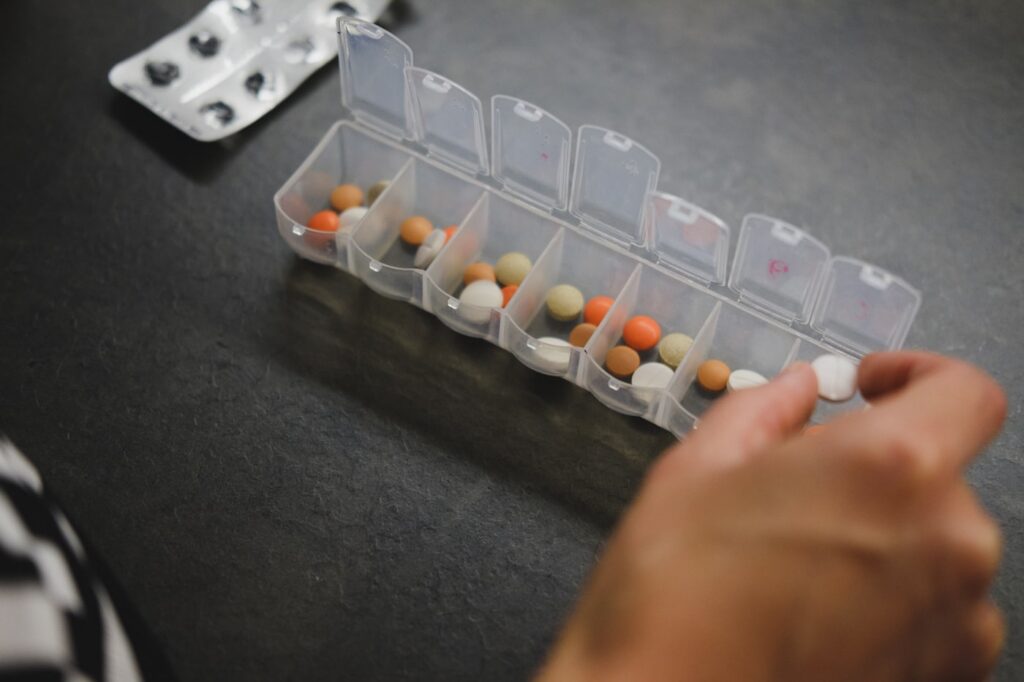
Illustrative photograph. Neither the person nor the setting is connected to this practice.
Your medication list
This is more important in rheumatology than in most specialties, for two reasons. Several rheumatic conditions are triggered or worsened by medicines, and several rheumatology treatments interact badly with drugs people do not think of as drugs.
Write down all of it
- Prescription medicines with the dose and how often you take them
- Anything bought over the counter, particularly ibuprofen, naproxen and aspirin
- Vitamins, minerals and supplements, including turmeric, fish oil and high-dose vitamin D
- Herbal preparations and traditional remedies
- Anything injected, infused or applied to the skin
- Medicines you were prescribed but stopped, with the reason why
That last item carries real weight. There is a large difference between a medicine that did not work after three months at a full dose and one that was abandoned after a fortnight because of nausea that would have settled. The two lead to completely different next steps, and only you know which happened.
Photographing the boxes is an acceptable substitute for a written list, and better than trying to recall names in the room. Bringing the boxes themselves is better still.
Original laboratory reports are the single most valuable thing you can carry through the door.
Book Your VisitPrevious test results, and why the report matters
Bring the actual reports. This is the single most common piece of advice given in rheumatology and the most frequently ignored, usually because people assume the specialist can already see everything. Unless the testing was done within the same health system, they generally cannot.
The difference a report makes
A letter saying your ANA was positive tells a rheumatologist almost nothing. The report tells them the titre, whether it was 1:80 or 1:1280, and the staining pattern, and those details change the interpretation completely. The same is true across the board: an inflammatory marker means something different depending on how high it was and how it has moved since.
What to ask for
- Laboratory reports showing values, units and reference ranges
- Radiology reports for X-rays, ultrasound, MRI or DEXA scans
- Clinic letters from any specialist you have already seen
- Discharge summaries if you have been admitted to hospital
- Biopsy or pathology reports if any tissue has been sampled
Older results are still worth bringing. A normal inflammatory marker from three years ago establishes a baseline, and a bone density scan from five years ago is what makes a new one interpretable rather than merely a number.
Anything that arrives before you do is time you get back during the appointment.
Send Records AheadA short written history
Symptoms that fluctuate are almost impossible to reconstruct accurately under the mild pressure of a consultation. Ten minutes with a piece of paper the night before is worth more than any single test you will have.
What to write down
- When the trouble began, at least to the nearest month
- Which joint or area was affected first, and what followed
- How long stiffness lasts in the morning, in minutes
- Whether rest makes it better or worse, and whether movement helps
- Whether it wakes you at night, and if so in which part of the night
- Anything that reliably triggers a flare
- What you can no longer do that you could do a year ago
That final point is often the most useful sentence in the whole appointment. Being unable to open a jar, turn a key, fasten a button or climb stairs without pausing describes function in a way that a pain score never manages.
If you have photographs of a swollen joint or a rash taken during a flare, bring them. Rheumatological signs have an inconvenient habit of disappearing on the day of the appointment, and a clear photograph of a genuinely swollen knuckle is real evidence.
Ten minutes of preparation the night before changes what a first visit can achieve.
Arrange Your AppointmentWhat to wear, and who to bring
The examination covers joints across your whole body. Clothing that pushes up above the elbow, trousers that roll above the knee and shoes that come off easily all make it faster and less awkward. If your feet are part of the problem, remember that they will be examined, which is worth knowing before you choose socks.
Avoid nail polish if your nails or hands are part of why you are being seen. Pitting, ridging and separation of the nail from its bed are useful signs in psoriatic arthritis, and polish hides all three.
Bringing someone with you
You are welcome to. A second person remembers different details, and it helps to have someone else present when a good deal of information arrives at once. If you would prefer them to step out during the examination, say so and that is easily arranged.
If you need an interpreter, tell the office when you book rather than on the day. PLACEHOLDER: confirm what language support the practice offers and how it is arranged.
Unsure whether an old report is worth bringing? Bring it. We would rather have too much.
Call Our OfficePLACEHOLDER: confirm what identification and documentation the front desk actually requires, whether forms are sent in advance, whether records can be emailed or faxed ahead, and the fax number or portal address for sending them. Have the clinical items on this list physician-reviewed.
Frequently asked questions
What to Bring: common questions
What if I cannot get my old records in time?
Come anyway. An appointment with an incomplete record is still worth having, and the missing pieces can be requested afterwards. Do not delay being assessed while waiting for paperwork.
Do I need to bring the actual scan images?
The reports matter most, because that is what a rheumatologist reads. Bring images if you have them on a disc or in a portal, but do not let their absence stop you attending.
Should I bring my medication boxes or just a list?
Either works, and the boxes are marginally better because they carry the exact strength and formulation. A photograph of each box is a reasonable middle ground.
Is it worth bringing results that were normal?
Yes. A normal result excludes possibilities and establishes a baseline, and knowing a test was already done prevents it being repeated unnecessarily.
Should I keep a symptom diary before the appointment?
If symptoms come and go, a few weeks of brief daily notes is genuinely valuable. Record which joints, how long stiffness lasted and anything that seemed to trigger it. Detail beyond that is rarely necessary.
What if my symptoms have settled by the time I am seen?
That happens often and does not waste the appointment. The pattern over time is diagnostic in itself, and photographs taken during a flare become especially useful in that situation.
Can I send my records ahead of the appointment?
PLACEHOLDER: confirm whether records can be emailed, faxed or uploaded before the visit, and give the address or number. Anything that arrives in advance is time recovered during the appointment.
Do I need to fast before the appointment?
Not for standard rheumatology blood tests. If a test requiring fasting is planned, the office will tell you when you book. PLACEHOLDER: confirm.

Still have a question?
Our office is happy to answer questions before you book. Call us or send a request and we will call you back.
Ask Us Your QuestionGet started
Request an appointment at our Katy clinic
New patients are welcome and referrals are accepted but not required for most plans.